

Lucky Colors for 2026 Feng Shui: A Beginner’s Fire Horse Guide

On this page
If you’ve searched “lucky colors for 2026 feng shui,” you’ve probably seen three different kinds of answers:
-
A short list of colors (usually red, green, gold)
-
A totally different list (often blue, white, yellow)
-
Or a confident-sounding explanation that still doesn’t tell you what to do next
Here’s the truth a beginner rarely gets told upfront: “Lucky colors” aren’t one single system. Different Feng Shui and Chinese astrology methods use color for different goals.
This guide will give you two things at once:
-
A beginner-safe 2026 color palette you can actually use.
-
A simple decision method so you know when yearly colors apply, when they don’t, and how to balance the strong Fire energy of 2026.
What you’ll be able to do after reading
By the end of this guide, you’ll be able to:
-
Understand why 2026 is called a Fire Horse year
-
Recognize which “lucky color” advice is annual, personal, or space-based
-
Pick one main color and one balancing color for your wardrobe or home
-
Avoid the most common mistakes (like overdoing red, or treating colors like superstition)
2026 in one minute: why it’s a Fire Horse year
Most public references mark the start of the zodiac year at Chinese New Year. In 2026, Chinese New Year begins February 17, 2026, and it’s the Year of the Horse (often described as the Fire Horse).According to the Smithsonian’s “2026: Year of the Horse” and Royal Museums Greenwich’s Lunar New Year dates table, that Horse year runs through early 2027.
You’ll also see 2026 described as Bing Wu (丙午).
-
Bing is a heavenly stem that corresponds to Yang Fire.
-
Wu is the earthly branch for Horse, commonly associated with Fire.
You don’t need to memorize stems and branches to use this guide, but it helps to know why 2026 is often described as extra “Fire-forward.”
If you’re curious about the structure behind these terms, the Hong Kong Observatory’s Heavenly Stems and Earthly Branches explainer is one of the clearest neutral references.
Why “lucky-color lists for 2026 Feng Shui” disagree
Before we talk colors, you need one mental model.
Think of “lucky colors” as three layers:
Layer 1: The year theme palette
This is the simplest approach.
-
It treats 2026 as a year with a strong Fire theme.
-
It recommends colors that support or harmonize that yearly mood.
This is helpful for:
-
Seasonal decor
-
Small wardrobe tweaks
-
Setting an intention for the year
It’s less helpful for:
-
Personalized results
-
Fixing a specific room problem
Layer 2: Your personal BaZi element balance
BaZi (often called the Four Pillars) looks at your birth chart and asks:
-
Which elements are strong in you?
-
Which are weak?
-
How does the year’s energy interact with your baseline?
This is usually the best approach for:
-
What you wear often
-
What you carry daily (phone wallpaper, accessories, a scarf)
Why? Because it’s personal. Two people can experience the same year very differently.
Layer 3: Your space and annual Feng Shui (including Flying Stars)
Some Feng Shui methods change by direction and sector. That’s why you’ll see advice like:
-
“Use more Metal in one area, but avoid Metal in another.”
This is why a “universal lucky color” list can feel wrong in your home.
If you want the simplest beginner rule:
-
Use Layer 1 for a gentle year vibe.
-
Use Layer 2 when the color is on your body all day.
-
Use Layer 3 when you’re changing a specific room or corner.
Pro Tip: When advice doesn’t match, don’t assume one source is “lying.” Ask: is it talking about the year, a person, or a house sector?
So… what are the lucky colors for 2026 Feng Shui?
(You’ll also see this searched as 2026 Feng Shui lucky colors.)
For a beginner-friendly, blend-both approach, it’s more accurate to think in terms of a 2026 palette:
-
Colors that echo Fire (good in moderation)
-
Colors that feed Fire (Wood)
-
Colors that ground Fire (Earth)
-
Colors that cool or regulate Fire (Water)
-
Colors that add clarity and restraint (Metal)
Below is a practical “use-this” palette, with simple ways to apply it.
2026 lucky colors, explained by element
1) Vermilion, coral, brick red, rose
Element: Fire
Meaning (in plain language): Visibility, confidence, momentum, warmth
Why it’s associated with 2026:
-
2026 is widely described as a Fire Horse year, so Fire colors show up in many yearly palettes.
How to use it without overdoing it:
-
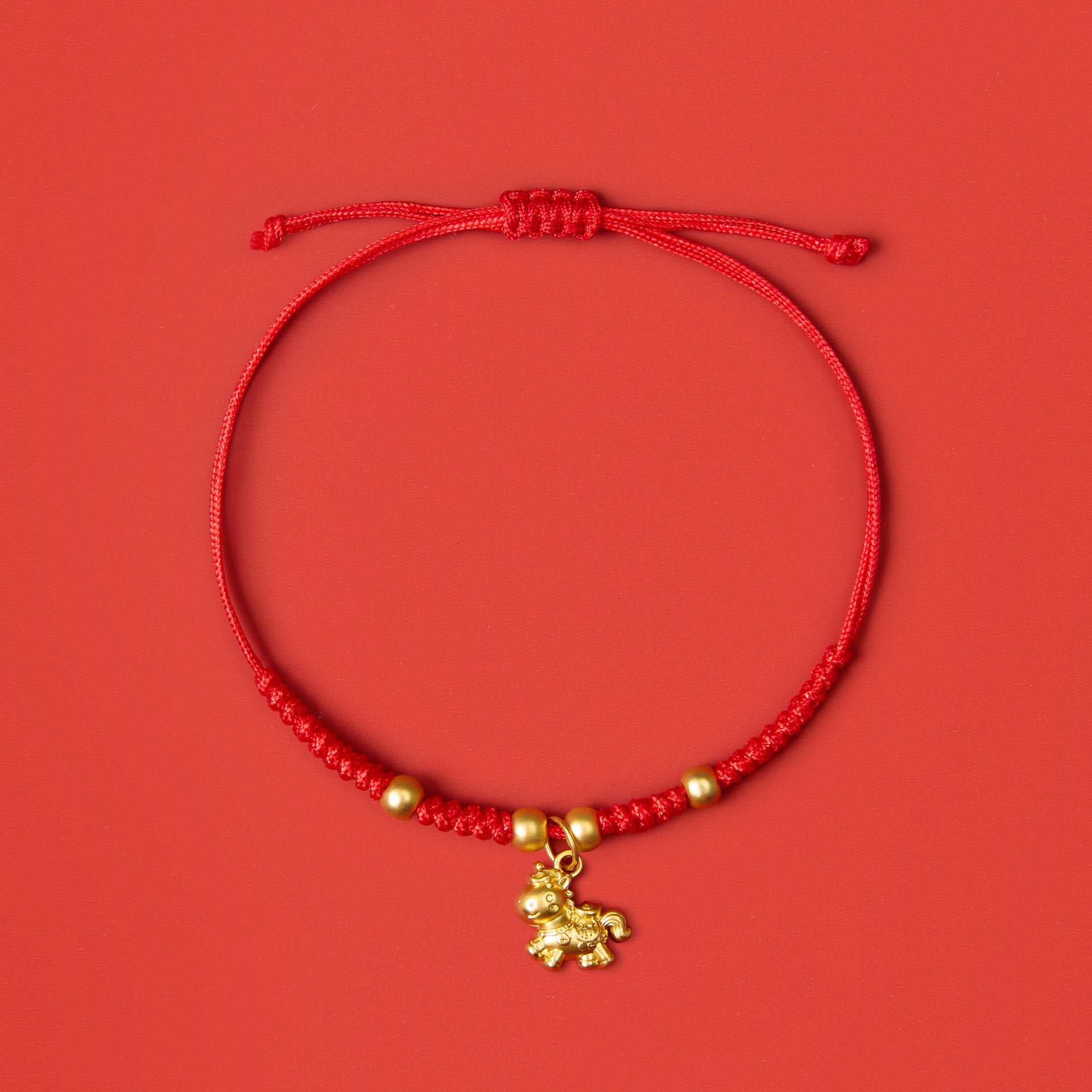
Choose one Fire accent at a time: lipstick, nails, a belt, a scarf, a red thread bracelet, a candle, a small artwork.
-
Use it in spaces where you want energy: entryway, office corner, dining area.
What to avoid:
-
Turning your whole bedroom into a red zone.
Feng Shui educators often describe red as powerful but not always restful; Anjie Cho’s guidance on the Feng Shui color red is a good reminder that “auspicious” doesn’t automatically mean “use it everywhere.”
Product pick: If you want a simple Fire accent you can wear daily, you can consider a red string bracelet collection.

-
Why it fits: A small red detail is an easy way to “turn up” Fire energy without repainting a room or overdoing red.
2) Emerald, jade, sage, soft olive
Element: Wood
Meaning: Growth, renewal, steady progress
Why it helps in a Fire year:
-
In the Five Elements generating cycle, Wood feeds Fire.
That doesn’t mean “add green everywhere.” It means:
-
If you want Fire energy to show up as creative momentum instead of burnout, Wood can support a healthier “fuel source.”
Beginner ways to use it:
-
A plant you can actually keep alive
-
A sage throw blanket
-
A green notebook for 2026 goals
Product pick: If you want to bring Wood energy into your everyday look in a subtle way, you can consider the Natural Jadeite Zodiac Animal Pendant.

-
Why it fits: Jade-green tones echo the Wood palette and pair easily with neutrals or white/gray accents.
3) Gold, warm yellow, sand, beige, ochre
Element: Earth
Meaning: Grounding, steadiness, “settling” the nervous system of a space
Why Earth matters in 2026:
-
Fire can feel fast. Earth helps you land that energy.
Easy applications:
-
Neutral bedding with warm undertones
-
Ceramic decor, pottery tones, stone textures
-
A warm beige wall or rug (if you’re redecorating)
This is the palette category that often makes 2026 advice feel more “practical” and less dramatic.
Product pick: If you like Earth tones because they feel steady and wearable, you can consider the Feng Shui Pendant Necklace with Lucky Charm.

-
Why it fits: Warm gold/earthy styling is a classic way to “ground” a Fire-forward year without adding more intense color.
4) Navy, deep blue, ink, soft black
Element: Water
Meaning: Cooling, reflection, regulation
How Water relates to balancing Fire:
-
In the Five Elements controlling cycle, Water controls Fire.
That’s the key idea beginners can use without getting overly technical.
A clean explanation of how the generating and controlling cycles work is in Clinical Gate’s overview of Five Elements theory (it’s written in a traditional-medicine context, but the cycle logic is what we’re borrowing here).
Beginner ways to use Water tones:
-
A navy bag, shoes, or jacket
-
Dark blue curtains (especially in an office)
-
A black frame around art (instead of a bright red frame)
Caution:
-
If you already feel low-energy or heavy, go for navy or soft charcoal rather than pure black everywhere.
Product pick: If you want a Water-toned piece that reads calm and reflective, you can consider the Precious blue guanyin Tibetan Thangka Amulet.

-
Why it fits: Deep blue is an easy “cooling” color to pair with beige/white when Fire energy feels too intense.
5) White, pearl, light gray, metallic accents
Element: Metal
Meaning: Clarity, boundaries, precision, “clean lines” energy
Why Metal can be useful in a Fire year:
-
Metal tends to bring order and definition—helpful when Fire feels scattered.
How to use it:
-
White space in your room (declutter + simplify)
-
Light gray textiles
-
A small metallic object on a desk (not a whole room of shiny chrome)
Product pick: If you want a Metal-leaning look that feels structured and symbolic, you can consider the Yin-Yang Taiji Eight Trigrams Symbol Feng Shui Pixiu Bracelet.

-
Why it fits: Black-and-white contrast and clean iconography match the “clarity and boundaries” vibe many people want in a Fire-forward year.
Which elements do these 2026 colors represent?
Here’s the quick mapping used in this guide (a simple Feng Shui color meanings five elements reference):
-
Fire: red, coral, rose, purple (use as accents)
-
Wood: green tones
-
Earth: yellow, beige, sand, warm neutrals
-
Water: blue, navy, soft black
-
Metal: white, pearl, light gray, metallic accents
If you’ve seen different mappings, it’s usually because:
-
A source is talking about cultural symbolism rather than Five Elements, or
-
A source is using a specific school or method (Flying Stars, personal BaZi, etc.).
Are the colors different because 2026 is a Horse year?
(Another common phrasing is year of the Horse 2026 lucky colors — and yes, the zodiac year label is part of why lists emphasize Fire tones.)
Yes—and here’s what that actually means.
The “Horse” label is not just a mascot. It’s one way to describe the year’s branch energy.
In simplified terms:
-
Horse years are often associated with motion, visibility, and fast shifts.
-
2026 is commonly described as Fire Horse, so many yearly lists highlight Fire-supporting colors.
But the important beginner takeaway is this:
-
The Horse year influences the “year theme” palette.
-
It does not automatically override your personal balance or your space’s needs.
So if you feel like “red should be lucky but it makes me anxious,” you’re not imagining it. The year theme is only one layer.
Do universal 2026 lucky colors apply to everyone?
Not in a strict way.
A “universal” 2026 palette can be useful as:
-
A seasonal mood
-
A gentle nudge for small changes
But if you want the most personalized answer, you’d look at:
-
Your BaZi element balance (best for what you wear and carry)
-
Your home’s directional energy (best for where you place colors)
If you’re a beginner, the safest approach is:
-
Choose one color from the year palette that feels supportive.
-
Pair it with one balancing color.
-
Use them as accents—not as a full identity overhaul.
How do colors balance Fire energy in 2026?
(You may also see this topic framed as 2026 Fire Horse Feng Shui — the balancing idea is the same: regulate strong Fire with Water/Earth/Metal tones, then use Fire as an accent.)
Balancing Fire doesn’t mean “turn Fire off.” It means shaping Fire into something useful.
Here’s a beginner-friendly way to think about it:
-
Fire can feel like: momentum, passion, visibility, courage.
-
Too much Fire can feel like: impatience, drama, burnout, restless sleep.
So color balancing asks: what do you need more of—fuel, grounding, or cooling?
If you want Fire to feel confident (not chaotic)
Try:
-
Wood + Fire: sage + coral, emerald + warm red accents
Use case:
-
creative work
-
visibility goals
If you want Fire to feel steady (not exhausting)
Try:
-
Earth + Fire: warm beige + small red accents
Use case:
-
routines
-
home stability
If you want Fire to feel calmer (not overstimulating)
Try:
-
Water + neutral: navy + pearl/white, soft black + beige
Use case:
-
sleep
-
stress reduction
This logic comes straight from the idea that Five Elements include both generating and controlling relationships; Clinical Gate’s explanation of sheng and ke cycles is one of the clearer summaries of that “build vs regulate” concept.
Key Takeaway: In a Fire-forward year, your “lucky” color choice is often less about adding more red—and more about choosing the right counterweight.
Myths vs facts about lucky colors
Myth: “If I wear the right color, I’ll automatically be lucky.”
Fact: Color is best used as a supportive cue—a way to anchor intention and shape your environment. It’s not a guarantee.
Myth: “The 2026 lucky colors are the same for everyone.”
Fact: Yearly palettes are general. Personal BaZi balance and your space’s needs can change the best choice.
Myth: “If 2026 is Fire Horse, I should go all-in on red.”
Fact: If your life already feels fast or intense, more Fire can backfire. Many people do better using red as a small accent and leaning on Earth/Water/Metal tones for stability.
Myth: “If a color is ‘unlucky,’ I must avoid it completely.”
Fact: Extreme rules are rarely helpful. Most Feng Shui educators emphasize context and intention over fear-based prohibitions.
Quick-start: the simplest way to use lucky colors in 2026
(If you were searching how to use lucky colors feng shui, start here.)
If you want a no-overwhelm routine, use this.
Step 1: Pick one intention for the next 30 days
Examples:
-
“I want steadier focus.”
-
“I want calmer mornings.”
-
“I want more confidence speaking up.”
Step 2: Choose 1 anchor color + 1 balancing color
Use this menu:
-
Want more visibility → coral/red + beige
-
Want more steady growth → green + white
-
Want more calm → navy/blue + warm beige
-
Want more clarity → white/gray + sage
Step 3: Apply it in one outfit and one small home zone
Examples:
-
Outfit: scarf + shoes, or shirt + bag
-
Home zone: entry table, desk, bedside
Step 4: Keep it small for a week
No repainting. No panic shopping.
Just observe:
-
Does this feel supportive?
-
Does it make the space calmer or more scattered?
That’s the beginner-friendly spirit of Feng Shui: adjust based on feedback, not fear.
Common mistakes when using lucky colors
These are the traps that make “lucky colors” feel ineffective.
Mistake 1: Using too many strong colors at once
Color can be a powerful tool, but overload can create visual noise. QC Design School specifically calls out using “too many colors (or heavy ones like black or red)” as a common mistake.See QC Design School’s Feng Shui mistakes list
Fix: Choose one anchor color and one support color. Let the rest be neutral.
Mistake 2: Flooding restful spaces with Fire colors
Red can be energizing. That’s the point.
But in a bedroom, “energizing” can become “restless.” Even educators who love red still warn against using too much of it in places meant for calm. Anjie Cho’s note on red in Feng Shui is a practical reminder to use it thoughtfully.
Fix: Use Fire colors as small accents in active areas, not as a full-room theme.
Mistake 3: Treating Feng Shui like superstition or doom
Patricia Lohan highlights how beginners can slip into rigid thinking—like believing one “bad” factor means everything is doomed.Patricia Lohan’s common Feng Shui mistakes
Fix: Treat colors as one gentle lever in a bigger system: layout, clutter, light, function, and intention.
Mistake 4: Ignoring what you actually need
If 2026 feels fast, you may not need “more Fire.” You may need:
-
Earth (grounding)
-
Water (cooling)
-
Metal (clarity)
Fix: Choose colors based on your lived experience, not just a yearly list.
Mistake 5: Making expensive changes before testing
Painting a room is a commitment. A scarf is not.
Fix: Test with low-stakes swaps first.
FAQ: your 2026 lucky color questions, answered
1) Which elements do these 2026 colors represent?
-
Fire: red/coral/rose/purple
-
Wood: greens
-
Earth: gold/yellow/beige/sand
-
Water: navy/blue/soft black
-
Metal: white/gray/metallic accents
2) Are colors different because 2026 is a Horse year?
They can be, because the yearly theme is often framed as Fire Horse, so Fire-supporting colors show up more. But it’s only one layer—personal and space-based methods can change what’s best for you.
3) Do universal 2026 colors apply to everyone?
They apply best as a general palette and a light touch. For personal accuracy, BaZi element balance is more relevant; for rooms, sector-based Feng Shui methods can be more relevant.
4) How do colors balance Fire energy this year?
By choosing counterweights:
-
Water tones to regulate Fire (control cycle)
-
Earth tones to ground Fire
-
Metal tones to add clarity and boundaries
5) What are common mistakes when using lucky colors?
-
Overusing strong colors (especially red/black)
-
Putting high-energy colors in restful spaces
-
Treating colors like guarantees or fear-based rules
-
Ignoring personal needs and room function
-
Making big changes before testing
Next steps (gentle, beginner-friendly)
If you want a simple way to apply this without overthinking, start with one small zone—your desk, entryway, or bedside—and choose one anchor color plus one balancing color.
For more beginner-friendly ideas that connect the year’s theme to practical home tips, you can read KarmaBless 2026 Feng Shui essentials.
And if you’re curious how the Year of the Horse theme is often discussed for different zodiac signs (without treating it as destiny), KarmaBless’ Year of the Horse 2026 zodiac guide is a helpful companion.
Optional footer note (glossary-style learning): If you want a plain-English breakdown of BaZi terms like Heavenly Stems, Earthly Branches, the Sexagenary Cycle, and why Chinese New Year matters in chart reading, this KarmaBless guide is a good reference: BaZi & Chinese New Year terms guide.